Abstract
Purpose – Cause-related marketing (CRM) is an ever growing marketing strategy developed by companies that may result in a win-win-win strategy for business, non-profit organizations and society. However, the specific relationship between CRM and consumers purchase intentions (PI) has been analyzed in a fragmented way within the mainstream literature. Grounding on this, the purpose of this paper is to give a more comprehensive and fine grained view of this phenomenon, testing the effect of several moderators on the relationships between CRM and consumers PI in two different countries. Design/methodology/approach – The sample consists of 234 Italian (individualistic culture) and 164 Brazilian (collectivist culture) consumers surveyed online. Ordinary least squares analysis has been carried out in order to test the moderator effects hypothesized. Findings – Regarding Italian respondents, the author found positive evidence for moderator effects of the perception of CRM goal achievement (GA), brand-fit (BF) and gender. On the contrary, the author did not find a significant moderator effect of brand-use, while the author found it significant but negative for Brazilian respondents. Moreover, the author found that the perception of CRM GA does not moderate the aforementioned relationship for Brazilians while BF and gender still have positive effects. Originality/value – A more fine grained picture of the CRM–PI relationships have been provided through the empirical test of several moderators, finding different effects in individualistic (Italians) and collectivist culture (Brazilians), thus deriving interesting implications in the international marketing field of research. Keywords CRM, International marketing, Cross-cultural studies, Consumer behaviour, Moderators, Cause-related marketing Paper type Research paper
1. Introduction
The scientific debate on corporate social responsibility and consumer expectations has thoroughly analyzed the relationship between economic and social performance of companies (Becker-Olsen et al., 2006; De Abreu et al., 2012; Bresciani et al., 2016). In this context, a key question is to what extent consumers are willing to reward good corporate behavior through their consumption decisions (Beckmann et al., 2006; Moosmayer and Fuljahn, 2010; Vrontis et al., 2017).
Driven by the consumer demand for companies to be socially responsible, cause-related marketing (CRM) is a kind of corporate social responsibility initiative (Chatzoglou et al., 2017), fundraising innovation (Docherty and Hibbert, 2003) or marketing strategy (Robinson et al., 2012) that has become very attractive in recent years. In CRM, companies “join with charities or ‘causes’ to market a product or service for mutual benefit” (Krishna, 2011). Several studies connected CRM to innovation (Christofi et al., 2014; Christofi, Leonidou, and Vrontis, 2015; Christofi, Leonidou, Vrontis, Kitchen and Papasolomou, 2015), to strategy and competitive advantage (Christofi et al., 2013) and obviously to different aspects of marketing (Docherty and Hibbert, 2003). As these studies pointed out, a purchase by consumers generates a donation by the firm to a non-profit organization. The resulting partnerships between firms and non-profit organizations can raise significant funds for the latter supporting a social cause and, at the same time, improving performance for businesses (Grolleau et al., 2016; Bonfanti et al., 2018). A basic assumption has been that when it works effectively, CRM is convenient for everyone resulting in a win-win-win strategy because: firms increase sales and improve their image (Hawkins, 2012); non-profit organizations boost public awareness, images and donation amount, also targeting consumers who are not direct donors (Wymer and Samu, 2009; Michaelidou et al., 2015); and consumers benefit from using the product and from the pleasure derived from donating to a cause (Strahilevitz and Myers, 1998; Altıntas et al., 2017). A growing number of scholars put the attention on how CRM may be practically more effective in order to find out which are the factors that influence the success of these initiatives (e.g. Pracejus and Olsen, 2004). In fact, many companies are nowadays engaging in CRM activities developing some targeted marketing campaigns, which suggest that in practice CRM may achieve positive results. However, despite the ever growing attention and real-life examples within the nowadays society, scholars and researchers developed fragmented pieced of research on the heterogeneous factors that improve the effectiveness of CRM, in particular those affecting the specific relationship between CRM and consumers purchase intentions (PI). Previous research has described some specific aspects or enabling factors in the context of CRM initiatives, generally focusing on the study of one or a couple of them that can alter different kinds of consumer behaviors, such as customer attitudes, consumer reactions, consumer perceptions of CRM or of firm behaviors. For example, Grau and Folse (2007) showed the importance of donation proximity and message framing on CRM campaign attitudes and participation intentions of less-involved consumers. The work of Nelson and Vilela (2017) discussed about the different response to a CRM campaign in relation to gender and to be a brand user or not. Furthermore, Koschate-Fischer et al. (2012) argued and found evidence of a positive relationship between the company’s donation amount and customers’ willingness to pay. Moreover, Pracejus and Olsen (2004) proposed the role of the fit between the company and the charity in improving the effectiveness of CRM campaigns. Furthermore, Robinson et al. (2012) introduced a component of choice in the CRM campaign, so that the company can give a part of the value spent to buy the product to a charity chosen by the consumer. Taking this scenario as a starting point, this study develops and empirically tests a model aimed at analyzing the impact of CRM on consumers PI, pondering the leverage of four moderator factors which can affect positively or negatively the relationships between CRM (as independent variable) and consumers PI. In doing so, we grounded on mainstream literature on the determinants of CRM consumer perceptions considering the following factors: the perception of CRM goal achievement (GA), the brand-fit (BF), the brand-use (BU) and the gender of target consumers. More specifically, this research widens the previous literature on CRM effectiveness in three main ways. First, the literature proposes only few articles that document the consumers’ reaction to a CRM message in relation to different variables simultaneously. In this sense, the present research contributes to the literature by exploring several factors that affect/moderate the
relation between CRM and consumer buying behavior, in order to define a broader analysis scheme of the phenomenon. While gender and brand-cause fit have been widely addressed in relation between other CRM studies (e.g. Chéron et al., 2012; Anuar and Mohamad, 2011), only few of them have investigated the perception of these factors as moderators of the CRM–PI behavior. Moreover, consumers PI the perception of CRM GA and BU have been addressed by a very limited range of studies in this context of analysis (two notables exception are Robinson et al., 2012; Nelson and Vilela, 2017 under different circumstances and relationships) and there is a need to better understand these factors within the aforementioned relationship. Second, this study intends to pioneer efforts to analyze consumer behavior variations from a cross-cultural standpoint (Kipnis et al., 2014) and to address key questions relevant to the development of a cross-cultural marketing strategy (Engelen and Brettel, 2011). Thus, we extend literature on consumer buying behavior by providing evidence on the impact of a collectivistic vs individualistic value set. This is an important contribution due to the fact that not many cross-cultural studies have been provided in the CRM field of research (e.g. La Ferle et al., 2013). Third and connected to the second, we empirically test the moderating effect of the perception of CRM GA, the BF, the BU and the gender of target consumers in two different contextual setting analyzing consumer behavior in individualistic (Italians) and collectivist (Brazilians) countries (see Hofstede, 1984). In collectivist societies, people subordinate their individual goals to the mission of the collective; on another hand, in individualistic societies people are used to place the personal goals ahead of the in-group goals (Triandis, 1993). Hence, the geographical contexts of analysis may provide original contribution for the international marketing discipline, highlighting how cultural differences impact on CRM and consumers behaviors (Vaidyanathan et al., 2013). Moreover, Italian and Brazilian contexts of analysis have been scarcely addressed in the CRM literature and this is quite unusual because many studies on related topics, such as CSR, have been deeply investigated in these specific geographical regions (e.g. Perrini et al., 2007; de Abreu et al., 2012; Santoro et al., 2019) addressing cultural and geographical characteristics as relevant factors. Our analysis is based on an online survey on 234 Italian and 161 Brazilian respondents. We found interestingly heterogeneous results that showed different consumers behavior, deriving insights and CRM implications for international marketing scholars and managers. The rest of the paper has been organized as follows: first, CRM has been introduced and some studies on its impact on consumers PI have been provided; second, several hypotheses regarding different moderator factors on the above relationship have been propose; third, the research design along with the variables used in the study has been proposed. In the last section, results of our analysis have been presented as well as their discussion and implications, limitations and future lines of research.
2. Literature backbone and hypothesis development
American Express is generally credited with pioneering the concept of “CRM,” phrase coined by their marketing people in 1983, raising funds to restore the Statue of Liberty (Ross et al., 1991). The first conceptualization of CRM, instead, is from Varadarajan and Menon (1988, p. 80): “CRM is the process of formulating and implementing marketing activities that are characterized by an offer from the firm to contribute a specific amount to a designated cause when customers engage in revenue-providing exchanges that satisfy organizational individual objectives.” This amount is generally presented as a percentage of the donated price; nonetheless, it is becoming increasingly common to specify the contribution in absolute terms (e.g. “2 euros donated for each unit sold”) (Chang, 2008). For example, in 2008, Starbucks donated 50 cents per sale of exclusive RED Starbucks beverages to the Global Fund for the fight against AIDS, tuberculosis and malaria.
CRM campaigns include a specific corporate social proposal, characterized by a constant involvement in prosocial behavior through distinct initiatives designed to improve the sustainability and responsibility of its products (Andreoni, 1989; Strahilevitz and Myers 1998; Arora and Henderson, 2007; Robinson et al., 2012). Previous research carried out in CRM has reported that consumers have particularly favorable attitudes toward CRM, companies in support of social causes and charitable organizations sponsored by CRM (e.g. Boenigk and Schuchardt, 2013; Ladero et al., 2015). These positive attitudes can affect consumers’ purchases for particular firms and products and generate awareness for a particular social cause (Bigné-Alcañiz et al., 2012; Human and Terblanche, 2012). Employing a sample of 100 students, Nan and Heo (2007) demonstrated that an advertisement containing a CRM message generated more favorable attitudes toward the company than those exposed to a message with no CRM. In the past, some surveys have been carried out to find out consumer perceptions about CRM. For instance, Ross et al. (1992) reported that almost half of their sample had purchased a product or service because of their desire to support a social cause. In a telephone survey, Smith and Alcorn (1991) showed that almost half of respondents interviewed would probably switch brands to support companies that give money to non-profit organizations. More recently, Demetriou et al. (2010) interviewed 820 people in Cyprus, outlining that most of the consumers still await companies to be sincerely involved in corporate social responsibility and, more specifically, in CRM. Chang and Cheng (2015) analyzed the psychological antecedents of the consumer skepticism toward advertising in CRM finding different mindsets related to the positive or negative consumer perceptions. Moreover, some academics (i.e. Wymer and Samu, 2009; Christofi et al., 2018) observed increasing PI for products linked to CRM, in particular when consumers felt that the cause was relevant to them. Thus, from many studies CRM programs favorably influence consumers’ PI (Che ́ron et al., 2012; Ladero et al., 2015). Thus, previous research has proven that CRM can affect customers’ behaviors and PI (e.g. Arora and Henderson, 2007; Chang, 2008; Grolleau et al., 2016; Hawkins, 2012; Nan and Heo, 2007; Pracejus and Olsen, 2004). In line with what has been said, we propose that consumers mature mostly positive attitudes toward CRM that reflect on companies supporting the social causes and the charity itself (Boenigk and Schuchardt, 2013; Ladero et al., 2015; Nan and Heo, 2007). These favorable attitudes affect the consumers’ purchases intentions of interested firms and its product, thanks to the involvement with the proposed social cause (Bigné-Alcañiz et al., 2012; Human and Terblanche, 2012). So, we propose the following baseline hypothesis: CRM positively impacts consumers PI However, the outcomes of a CRM program are significantly affected by several related factors. In this section, we propose different variables that may have an impact on consumers purchases of a product sponsored by a CRM campaign. These are: the perception of CRM GA, BF, BU and gender.
2.1 Perception of CRM goal achievement
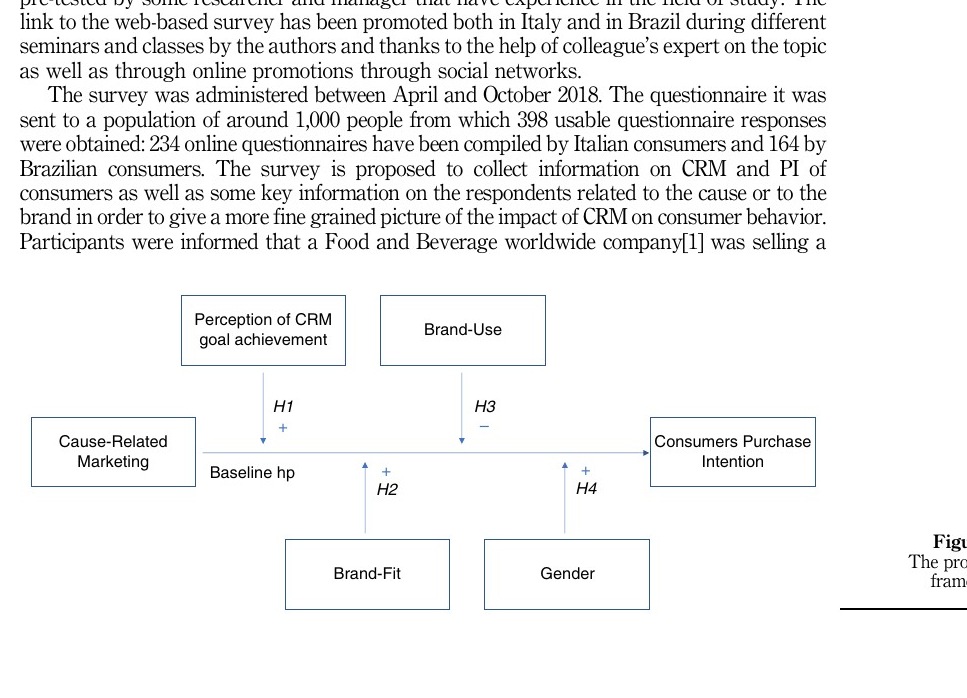
Since CRM is “characterized by an offer from the firm to contribute a specified amount to a designated cause when customers engage in revenue-providing exchanges that satisfy organizational and individual objectives” (Varadarajan and Menon, 1988, p. 80), the understanding of consumer subjective feelings and perception of CRM objectives achievement is assuming a strategic role. As a matter of fact, the perceived contribution of the campaign to the cause is of high importance, as this may influence the campaign’s success as well as the way in which organizations are perceived by the consumer. The perception of CRM GA refers to the proximity to the cause objectives (Drumwright and Murphy, 2001; Robinson et al., 2012). This has a strong impact on how consumers perceive their personal role in supporting the campaign objectives achievement. In fact, when the target is perceived as close, people are likely to feel their choice of a product related relation between to a cause as more relevant given that the contribution given from the customer to the cause is a relatively high percentage of the remaining amount that the charity has to collect consumers PI (Förster et al., 1998) and thus moves the charity considerably closer to achieve its objective being making more effective and of value the contribution (Robinson et al., 2012). On the contrary, when the objective is farther away, the personal role perceived in supporting the cause to reach its target is probably low, since the contribution would leave the charity far from its declared objective (Koo and Fishbach, 2008). Moreover, when the CRM goal is distant from its target, people may feel that they are spending their money unhelpfully and this could reduce the value and the proven sense of participation in the CRM program (Norton et al., 2012). Thus, we hypothesize that: H1. The closer the perception of CRM GA, the higher is the effect of CRM on consumers PI.
2.2 Brand-fit
As several authors pointed out, company’s responsible initiative can add value, trust and reputation to products, improving their legitimacy (Phillips et al., 2002). In order to maximize the potential benefits of these activities, social responsible initiatives must be directly linked to the core business of the company. More specifically, in order to implement efficient and effective corporate social strategies from both an economic and a social point of view, the alignment between company value and strategy, corporate social responsibility actions and core business appears to be fundamental (Porter and Kramer, 2006). Furthermore, previous research suggested that the fit between the company’s brand and responsible activities is a key variable for higher performance arguing that the higher the responsible activities fit, the more positive the consumers’ evaluations (Becker-Olsen, Cudmore and Hill, 2006). In this vein, BF in CRM refers to the extent to which consumers perceive that the cause being supported in the CRM campaign has significant connections with the company’s core business and brand (Chéron et al., 2012). This means that the fit between the company and a cause can be described by the way the two parties seem to connect or make sense together (Robinson et al., 2012). In this context, Strahilevitz and Myers (1998) argued that fit among brand and cause could influence the success of CRM program. We can draw from several simile behaviors to support this. BF is able to assist the transfer of positives from an object (celebrity, main brand, etc.) to the mark associated with the object (Pracejus and Olsen, 2004). If the fit is significant, it is likely that the firm is also better able to help the cause because fit improves the transferability of competence, synergies in activities, skills, products, technologies or markets (Zdravkovic et al., 2010). In our context, this means that CRM campaign may be more effective and may achieve higher effect on consumers PI when the perceived fit between the company and the cause is higher. So, we proposed the following: H2. The higher the brand-fit, the higher is the effect of CRM on consumers PI.
2.3 Brand-use
Recently, Nelson and Vilela (2017) sustained that prior BU or buying behavior can affect the reaction of individuals to CRM campaigns because consumers may have more direct or indirect brand relationships. People who previously purchased a good of a certain brand should not be considered equivalent to those who had not purchased a brand yet (or could not remember if they had already bought it). Nelson and Vilela (2017) also suggested that, after contact with the CRM campaign, there is a significant increase in PI, in particular for non-typical consumers of the brand. This appears to give credit to the “weak theory” of CRM or the advertising effects in that product usage has more incidence than ads or CRM programs (Vakratsas and Ambler, 1999). The “weak theory” of advertising argued that the main role of advertising is the strengthening of the brand (Barnard and Ehrenberg, 1997). In this perspective, advertising can increase awareness even if without strong persuasive effects on purchasing behavior. In fact, consumers are continually urged to remember brands through advertising, but they generally pay attention only to brand announcements for which they already have positive past experiences. For non-brand users, exposure to an advertisement does not significantly affect their buying intentions. In the specific context of consumers of charity bracelets, Yurchisin et al. (2009) showed that attitude toward purchasing a cause-related fashion product was not a good predictor of behavior. Lafferty and Goldsmith (2005) and Lafferty (2009) have noticed in their studies greater persuasion (more positive brand attitudes and greater purchasing intentions) for the brand that people had never tried and, at the same time, less persuasion for the brand well known and already bought. Hamlin and Wilson (2004) found a little influence of CRM message on PI in the case of BU of a specific category of family products (such as milk). In the case of non-brand user, people do not have relevant associations or experiences with the brand so the exposure of the product to a CRM campaign may have a greater influence on consumers and positive persuasion can work through the transfer of positive effects (Nan and Heo, 2007). De facto, CRM linked to an important cause and a not well-known brand can help increase the chances of buying that brand to that of a well-known brand. As a result, brands for which the person shows no or little usage can take more advantage from CRM because consumers who are not familiar with the brand may not have developed relevant associations yet. Therefore, the CRM could favor the first purchase of the brand by non-buyers. On the contrary, CRM may have lower influence on people who have already bought brands that support causes they trust. So, we propose the following: H3. The higher the BU, the lower is the effect of CRM on consumers PI.
2.4 Gender
Ladero et al. (2015) proved that the attitude in relation to CRM is affected by some sociodemographic features and characteristics as for example gender, age, education, employment, income and children. Regarding gender, several academics have found that women may be less suspicious than men about CRM campaigns (e.g. Ross et al., 1992; Trimble and Rifon, 2006) and may show more positive behaviors toward the organization and the charity compared to men (Vilela and Nelson, 2016; Wang, 2014). For instance, Anuar and Mohamad (2011) found that adherence to the cause affects only women, who choose to sustain a campaign locally rather than internationally. Although some researchers fail to identify gender differences in attitudes toward CRM (e.g. Wymer and Samu, 2009) or only partially identify them (e.g. Shelley and Jay Polonsky, 2002; Saleh and Harvie, 2017), some studies have found that women could be more influenced by CRM than men (e.g. Trimble and Rifon, 2006; Vilela and Nelson, 2016). In fact, women tend to buy brands that support causes through CRM campaigns (Ross et al., 1992) and to make donations to charity (Shelley and Jay Polonsky, 2002) more than men. For example, Kropp et al. (1999) showed that the educational and thoughtful role of women in the society may be relevant in influencing their positive feelings about CRM. Shelley and Jay Polonsky (2002) discovered in focus groups and surveys that older individuals and women are more predisposed toward supporting a charity. Vilela and Nelson (2016) achieved the same conclusions through a survey in the USA.
Mesch et al. (2011) stated that males and females have differences in motivations for giving. Women, compared to men, have much higher levels as regards empathic concern relation between and the principle of care. Moreover, they have a greater chance to make a donation or to donate more money. For that reasons, females are usually more willing to buy a product to consumers PI sustain a cause compared to men (e.g. Anuar and Mohamad, 2011; Vilela and Nelson, 2016). In short, research has generally shown that gender affects consumers’ reaction to CRM and may have effect on consumers behaviors, thus we propose the following hypothesis: H4. The effect of CRM on consumers PI for females is higher than for males. In Figure 1, we graphically outline our hypothesis.
3. Research design
In this study, we choose a quantitative methodology through a survey approach to experiment and test our hypotheses. The chosen methodology ordinary least squares (OLS) allowed us to test the effects of moderators on the baseline relationship, that is widely used in management studies (Bresciani and Ferraris, 2016; Ferraris et al., 2017; Santoro et al., 2017; Erkutlu and Chafra, 2017), while previous studies on the topic used mostly experiments (e.g. Pracejus and Olsen, 2004). Since most aspects of consumer behavior are culture-bound (De Mooij and Hofstede, 2011), we chose a cross-cultural research methodology analyzing and comparing Italian (individualistic culture) and Brazilian contexts (collectivist culture). CRM and corporate social responsibility research are equally important and appropriate in these context, and conceptually equivalent (Malhotra et al., 1996). Data were collected using a questionnaire formed by close questions. The web-based survey (Dillman, 2000) has been built on the base of previous studies and has been pre-tested by some researcher and manager that have experience in the field of study. The link to the web-based survey has been promoted both in Italy and in Brazil during different seminars and classes by the authors and thanks to the help of colleague’s expert on the topic as well as through online promotions through social networks. The survey was administered between April and October 2018. The questionnaire it was sent to a population of around 1,000 people from which 398 usable questionnaire responses were obtained: 234 online questionnaires have been compiled by Italian consumers and 164 by Brazilian consumers. The survey is proposed to collect information on CRM and PI of consumers as well as some key information on the respondents related to the cause or to the brand in order to give a more fine grained picture of the impact of CRM on consumer behavior. Participants were informed that a Food and Beverage worldwide company[1] was selling a new product within its product range, associated with a CRM campaign. In fact, people can read that 10 percent of the paid price to buy the product will be donated to a charitable foundation. Taking a hint from the (RED) program, we propose a solidarity campaign where the contribution will be invested in actions to fight diseases as HIV/AIDS in Africa. Initially, respondents were asked to provide their personal information such as age and educational background. The demographic age was between 15 and 55 and this may be a very important issue to address because, compared with older generations, young and educated consumers would be more likely to support CRM campaigns (e.g. Chang and Cheng, 2015). In total, 33 percent of the Italian respondents (35 percent of Brazilians) are consumers between 19 and 26 years old, while 39 percent (33 percent of Brazilians) are between 27 and 35, making our sample mostly representative of Y generation. With regard to educational background, 44 percent of the Italian respondents (32 percent of Brazilians) have a Master’s degree, while 36 percent (31 percent of Brazilians) have a professional degree and only 7 percent of the total respondents have a Doctoral degree. In total, 53 percent of respondents were female and 47 percent were male.
3.1 Main variables used in the study
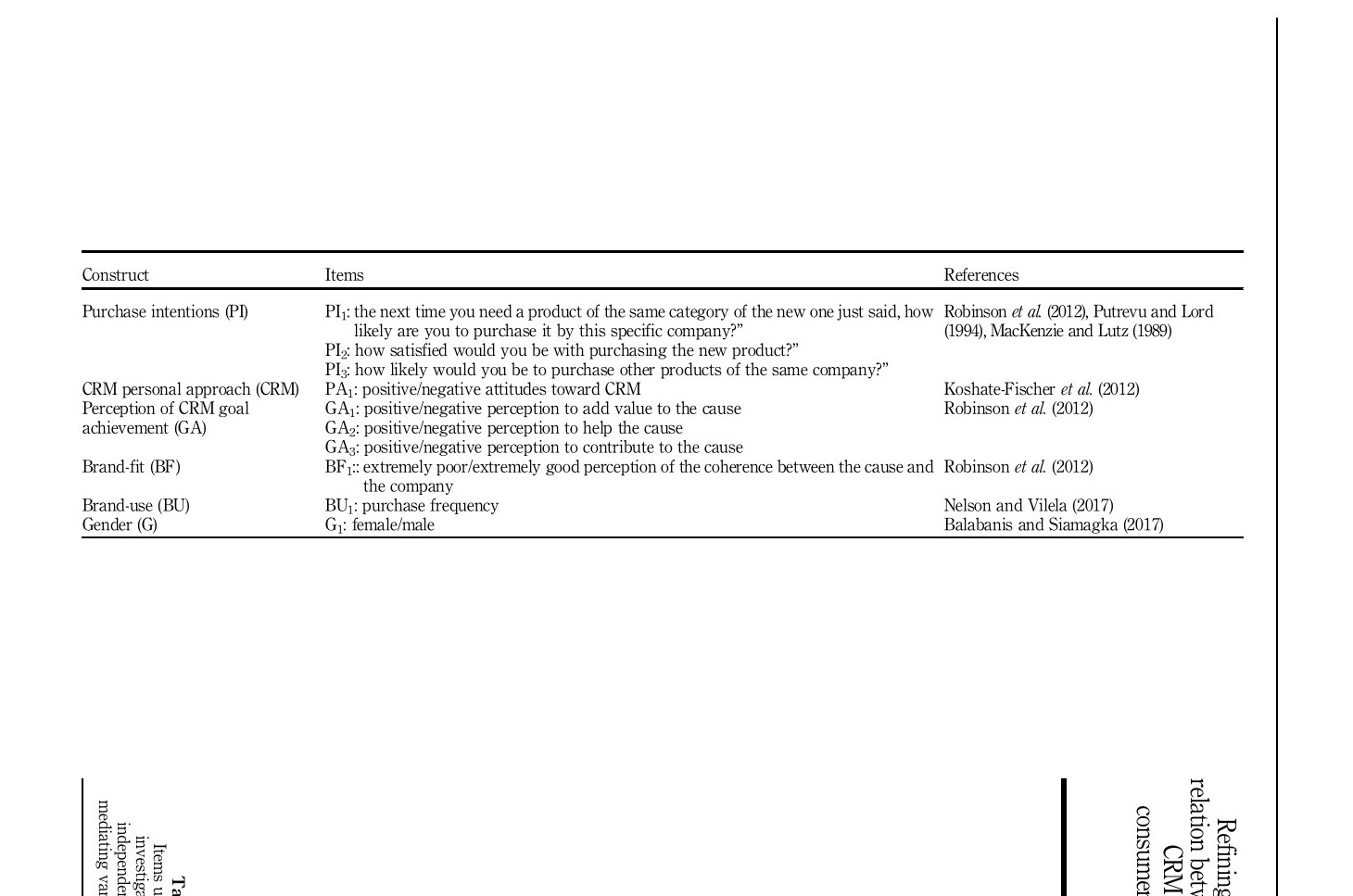
All variables were measured using existing validated constructs. Since the items were placed on a seven-point Likert scale, a higher score on each scale means a greater consonance with the question (Likert, 1932; Munshi, 2014). Variable measures are listed in Table I and were employed as follows. We measured consumers PI thanks to different items, inspired by the research of Robinson et al. (2012), in which the consumers expressed their opinion in a seven-point Likert scale on three items (1 = “not at all likely,” and 7 = “very likely” or 1 = “not at all satisfied” and 7 = “very satisfied”). After that, we took the average values of these three items to build the dependent variable (consumers PI). Then, we asked to target their personal approach with CRM adapting it from the study of Koshate-Fischer et al. (2012). Consumers expressed their opinion using a seven-point Likert scale (1 = “extremely negative attitude” and 7 = “extremely positive attitude), thus we built our independent variable (CRM). Regarding our first moderator variable, to evaluate the perception of CRM GA in this research we build on the study of Robinson et al. (2012) that considers that a near goal gives a greater perception of personal role in the CRM campaign studying this aspect directly and how it impacts on the consumer’s PI (see Table I for all the items used). To evaluate BF we proceed as follows (based on Robinson et al., 2012). First, we introduced the follow contextual factors: “We would like you to determine how well you think the causes fits with Company X. The fit between a company and a cause means how well the two organizations connect, or appear to make sense together.” Then, we collect information on consumers perceptions using a sevenpoint Likert scale ranging from 1 = extremely poor fit to 7 = extremely good fit. Moreover, we adapted the items used from Nelson and Vilela (2017) to evaluate BU asking for consumers’ purchase frequencies of the product. For gender (G), we create a dummy variable where 0 was for female and 1 was male (Balabanis and Siamagka, 2017). We also include some control variables that can influence the consumers PI based on some socio and demographic factors. To define the age, we used the methodology of Balabanis and Siamagka (2017) that consider a four-point Likert scale structured as follows: 0 if the age is between 1 and 18; 1 if the age is between 19 and 26; 2 if the age is between 27 and 35; 3 if the age is between 36 and 50; and 4 if the age is more than 50. In reference to the work of the latter, the educational background is asked in the form of a scale of values 1–7 as follows: junior high school; high school; college no degree; bachelor’s degree; master’s degree; professional degree; and doctoral degree. Some descriptive statistics and correlation matrix have been presented in Table II.
Brand-use (BU) Gender (G)
Brand-fit (BF)
CRM personal approach (CRM) Perception of CRM goal achievement (GA)
PI1: the next time you need a product of the same category of the new one just said, how Robinson et al. (2012), Putrevu and Lord
likely are you to purchase it by this specific company?”
(1994), MacKenzie and Lutz (1989)
PI2: how satisfied would you be with purchasing the new product?”
PI3: how likely would you be to purchase other products of the same company?”
Koshate-Fischer et al. (2012)
PA1: positive/negative attitudes toward CRM
GA1: positive/negative perception to add value to the cause
Robinson et al. (2012)
GA2: positive/negative perception to help the cause
GA3: positive/negative perception to contribute to the cause
BF1:: extremely poor/extremely good perception of the coherence between the cause and Robinson et al. (2012)
the company
BU1: purchase frequency
Nelson and Vilela (2017)
Balabanis and Siamagka (2017)
G1: female/male
Purchase intentions (PI)
References
Items
Construct
4. Results
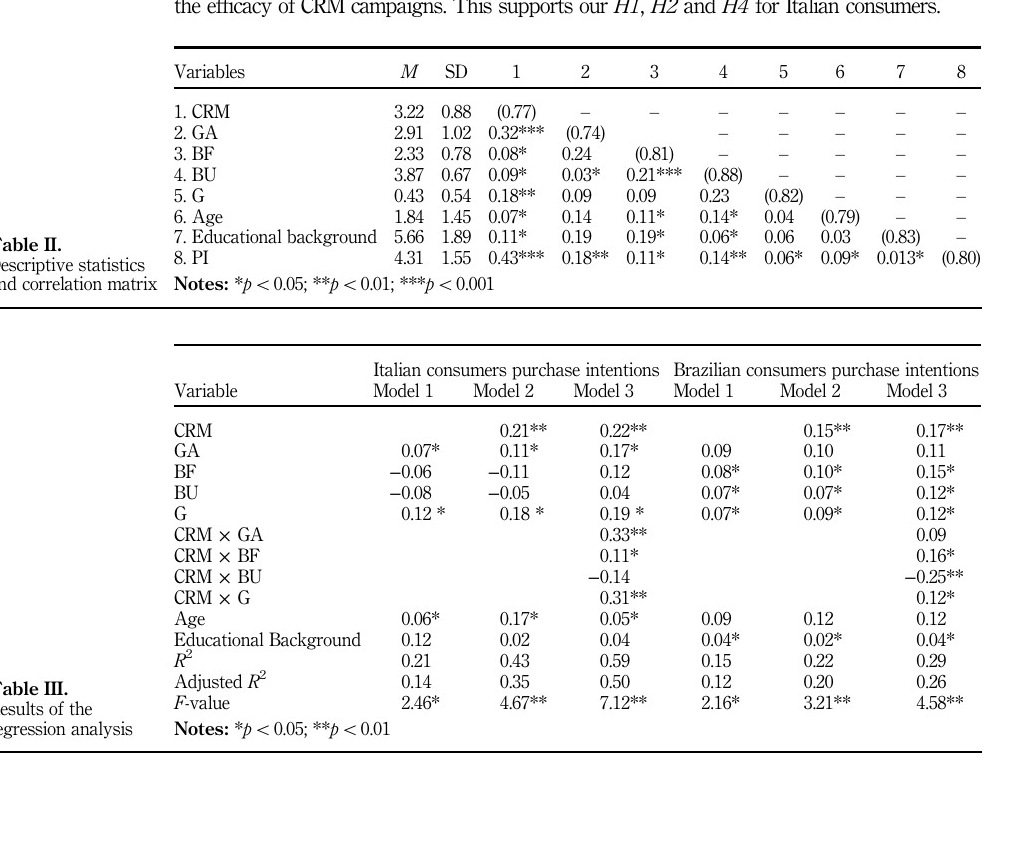
The hypotheses were tested using OLS regression analysis and the results are presented in Table III, distinguishing between Italian and Brazilian consumers PI. For both samples, Model 1 represents the effect only of moderators independently (perception of CRM GA, BF, BU and gender) and control variables on consumers PI. In this model, a low and significant effect has been showed by the perception of CRM GA (0.07), gender (0.12) and age (0.06) for Italian consumers and by BF (0.08), BU (0.07), gender (0.07) and educational background (0.04) for Brazilian consumers. Model 2, instead, is implemented to test the impact of CRM on our dependent variable. Our analysis showed a standardized coefficient of 0.21 for CRM for Italian consumers and of 0.15 for Brazilian consumers (significant at 5 percent level), thus confirming a positive relationship of CRM on consumers PI of both samples. This supports our baseline hypothesis. Finally, in Model 3, the interaction terms are proposed to test the interaction effects concerning the four moderators on the relationships between CRM and consumers PI. The results of the empirical analysis highlighted that three out four moderators have been showed positive and significant coefficients, but with some differences with regard to Italians and Brazilians. For Italian consumers in our sample, the coefficient for CRM × perception of CRM GA is 0.33 (significant at 1 percent level), the one for CRM × BF is 0.11 (significant at 5 percent level) and the one for CRM × Gender is 0.31 (significant at 1 percent level). This means that all the three moderators have a positive effect on the relationship between CRM and consumers PI, improving the efficacy of CRM campaigns. This supports our H1, H2 and H4 for Italian consumers. Variables
1. CRM
3.22 0.88 (0.77)
2. GA
2.91 1.02 0.32***
3. BF
2.33 0.78 0.08*
4. BU
3.87 0.67 0.09*
5. G
0.43 0.54 0.18**
6. Age
1.84 1.45 0.07*
7. Educational background 5.66 1.89 0.11*
Table II.
8. PI
4.31 1.55 0.43***
Descriptive statistics
and correlation matrix Notes: *p o0.05; **p o0.01; ***p o0.001
Variable
–
(0.74)
0.24
0.03*
0.09
0.14
0.19
0.18**
–
–
–
(0.81)
–
0.21*** (0.88)
0.09
0.23
0.11*
0.14*
0.19*
0.06*
0.11*
0.14**
–
–
–
–
–
–
–
–
–
–
–
–
–
–
–
–
(0.82)
–
–
–
0.04 (0.79)
–
–
0.06 0.03
(0.83)
–
0.06* 0.09* 0.013* (0.80)
Italian consumers purchase intentions Brazilian consumers purchase intentions
Model 1
Model 2
Model 3
Model 1
Model 2
Model 3
CRM
GA
0.07*
BF
−0.06
BU
−0.08
G
0.12 *
CRM × GA
CRM × BF
CRM × BU
CRM × G
Age
0.06*
Educational Background
0.12
0.21
R
0.14
Adjusted R2
F-value
2.46*
Notes: *po 0.05; **p o0.01
0.21** 0.11* −0.11 −0.05 0.18 *
0.17* 0.02 0.43 0.35 4.67**
0.22**
0.17*
0.12
0.04
0.19 *
0.33**
0.11*
−0.14
0.31**
0.05*
0.04
0.59
0.50
7.12**
0.09 0.08* 0.07* 0.07*
0.15** 0.10 0.10* 0.07* 0.09*
0.09 0.04* 0.15 0.12 2.16*
0.12 0.02* 0.22 0.20 3.21**
0.17**
0.11
0.15*
0.12*
0.12*
0.09
0.16*
−0.25**
0.12*
0.12
0.04*
0.29
0.26
4.58**
For Brazilian consumers in our sample, the coefficient for CRM × BF is 0.16 (significant at 5 percent level), the one for CRM × BU is −0.25 (significant at 1 percent level) and the one for relation between CRM × Gender is 0.12 (significant at 5 percent level). This means that two moderators have a positive effect on the relationship between CRM and consumers PI, improving the efficacy consumers PI of CRM campaigns. On the contrary, CRM × BU has a negative effect on the above mentioned relationship. This supports our H2–H4. Overall, our results fully confirmed our second and fourth hypotheses and partially confirmed our first (only for Italian consumers) and third (negative effect on Brazilian consumers) hypotheses.
5. Discussion and implications
CRM is becoming an effective and valuable marketing tool that companies use for many reasons such as improving performances, reputation, image, the number of products sold, etc. However, CRM faced criticism and skepticism, especially in relation to the company motivation for the initiative: as in the case of expensive products, consumers tend to perceive that the company is exploiting the cause to improve their sales (Boenigk and Schuchardt, 2013; Nowak and Clarke, 2003). CRM critics argue that consumers should contribute directly to non-profit organizations rather than through product purchases (Gaines, 2013). Nonetheless, Fraser et al. (1988) argued that cause-related products could bring an “anchor price” for donations in case people desist from donating to charities because they have difficulties estimating a socially acceptable donation amount and fear donating an inappropriate amount (Dhar, 1996). In fact, many studies showed that consumers are willing to reward companies that return to society by paying more for their goods and services (Nielsen Global Research, 2014). Our results confirm the positive relationship between CRM and consumers PI and this is also in line with some previous research that showed that consumers have more positive reactions to companies that engage in social responsibility programs such as CRM campaigns (e.g. Sen and Bhattacharya, 2001). Our main original results show that the effect of CRM on consumers purchasing intentions may be affected by several factors that companies need to evaluate before developing this strategy, also finding differences between consumers belonging to more individualistic or collectivistic society. While the literature on these factors is fragmented and only few studies tested and found evidence of multiple moderator variables, in this research we simultaneously proposed four factors that may influence our baseline relationship, testing them into two groups of Italian and Brazilian consumers. They are: perception of CRM GA, BF, BU and gender. We found positive evidence for moderator effects of the perception of CRM GA, BF and gender on Italian respondents. Differently, we did not find a significant moderator effect of BU on Italians while we found it significant and negative for Brazilian respondents. Moreover, we found that the perception of CRM GA does not moderate the aforementioned relationship for Brazilians while BF and gender still have positive effects. As the results suggest, the peculiarities within the two groups – individualistic or collectivistic – determine different approaches to the perception of CRM GA. As a matter of fact, within the individualistic group we can identify a linear path passing from CRM → perception of CRM GA→ consumers PI. A second general implication is about the influence of prior BU on consumers PI of collectivistic consumers. According to Hamlin and Wilson (2004), results suggest that in collectivistic contexts CRM may have a negative influence on people who have already bought brands that support causes they trust. Consequently, marketers might consider these results, when planning their CRM campaigns.
5.1 Theoretical implications
Currently, mainstream studies on the topic show only few articles that empirically test the consumers’ reaction to CRM campaigns in relation to different moderators simultaneously.
Thus, this research contributes to the CRM literature by exploring several factors that affect the relation between CRM and consumer purchasing behavior, in order to give a broader and fine grained explanation of the phenomenon. Among all the variables investigated, one of the most original implications of this research is related to the perception of CRM GA. In fact, the proximity to the objectives of the cause chosen by the firm is rarely addressed in CRM research landscape, leaving underexplored an important aspect of the CRM campaign (a notable exception is Robinson et al., 2012). Most interestingly, we found that only Italian consumers may be affected by the perception of CRM GA while this is not the case for Brazilians. This is probably linked to the more utilitarian and concrete individualist society in which Italians live, and with this study we add to existing knowledge on the topic proposing a further factor that may impact on the relationships between CRM and consumers PI. Another theoretical implication is the interestingly different results with regard to BU (La Ferle et al., 2013), where hard brand users show a negative moderating effect only on Brazilian consumers. Regarding the non-significant effect of brand user for Italians, it could also be the case in which CRM brand buyers were more persuaded and may have already developed strong attitudes and buying intentions. Thus, their PI did not improve after exposure to the CRM message, nor did they fall substantially later, but they are still high and marketing messages with CRM may simply reinforce buying intentions for a brand in which consumers already use (Nelson and Vilela, 2017). The results for the Brazilian consumers may be explained by the fact that heavy users should be more motivated to pay attention to the cause supported through CRM than to the manipulative motives of CRM (Chang, 2012) that, instead, attract more the attention of consumers with individualistic culture. In fact, when paying attention to the cause, brand users may be more motivated than non-brand users to become emotionally involved with it. These results show how cultural attitudes should take care in international CRM campaigns (Cadogan, 2012), with a particular attention in the case of previous purchase behaviors. A further important theoretical implication is that firms try to improve consumer confidence should consider identifying charities that are consistent with their product offerings (Rifon et al., 2004). Indeed, we found evidence that the fit between the brand and the cause can have a large impact on the success of CRM programs. This is in line with Pracejus and Olsen (2004) that found that in terms of dollar value trade-offs, the high-fit CRM program had roughly five times the incidence of the low-fit program and ten times the incidence in their second study. Evidently, perceived fit between the firm (and brand) and the cause is a relevant measure that should always be taken into strong consideration to any CRM program. This may support the results of Koschate-Fischer et al. (2012) which showed that BF has been found as a relevant factor that moderates the relationship between donation amount in CRM and willingness to pay of the consumer, making it a very important variable to carefully take care in this context. Finally, we give also an implication regarding the gender target where women have responded positively to the CRM campaigns more than men, confirming some previous research but testing it with a cross-cultural study and validating it in very different cultures (Wang, 2014; Ladero et al., 2015; Vilela and Nelson, 2016). This receptivity can be the result of a greater familiarity with CRM programs amid women since the campaigns have historically and mainly addressed them.
5.2 Managerial implications
Even more important in this context, companies need to carefully design and think to several and multiple factors that simultaneously affect consumer’s behaviors before developing a CRM campaign that can also cause negative financial and non-financial performances. In fact, although the effectiveness of CRM is generally demonstrated, in some cases the application of this strategy may have adverse and unexpected results (Grolleau et al., 2016). Practically speaking, the perception of CRM GA, BF, previous brand usage and relation between gender need to be carefully evaluated by firms and marketing managers before starting a CRM campaign. Regarding the first, one notable implication for managers is to take into consumers PI account the perceived role of the consumer within a CRM campaign. In fact, in each purchase of a product or a service, the consumer perceives a sense of involvement in the cause that goes beyond the mere satisfaction of the needs in particular when the purchase contributes to a “good cause.” In this paper, we showed that only Italian consumers give a high importance to the closeness to the CRM GA. This may be related to the more individualistic culture that affects consumer behaviors, making Italian respondents more utilitarian and concrete. So, the perception of CRM GA (or the way this message has been promoted or delivered by the company) is a factor that may lead to an improvement of the efficacy of a CRM campaign mainly (only in our research) on consumers that have a higher individualistic orientation. Regarding BF, the choice of the cause should be carefully thought by managers and marketing specialists in the case of international CRM campaigns. Regarding brand user, we found again significant differences among our sample of Italian and Brazilian respondents suggesting that managers that want to target consumers from a more individualistic culture need to know in advance that they may be less (or not) affected by the previous purchase brand behaviors while, on the contrary, consumers that have a more collectivistic culture may be negatively affected by this factor, de facto reducing the positive effect of CRM on their PI. Overall, a wider identification of the specific factors (and cultural differences) that may affect or not the effect of CRM on PI may open the space for managers to craft different, targeted and more efficacy international CRM campaigns.
6. Conclusion and future research
A key goal of our research was to examine the relationship between CRM and consumers PI. We found that CRM leads substantially to increase in the purchase behaviors of consumers as well as that several factors may improve the efficacy of this growing important marketing tool. Despite many studies focused on factors that affect CRM outcomes, we gave a clearer and fine grained view of the CRM phenomenon, in particular focusing on different factors that moderate the relationship between CRM and consumers PI, finding also interesting differences among culturally distant groups of consumers (Italians and Brazilians). Future studies should therefore continue in investigating factors that may amplify or improve the effectiveness of CRM on different outcomes of consumer behaviors in different cultural contexts (Lavack and Kropp, 2003; Chang and Cheng, 2015; Thrassou et al., 2018) or improve its awareness within both public and private organizations (Demetriou et al., 2018). This is also a limitation of our research that focuses only on Italian and Brazilian respondents, thus we cannot test using this sample other kind of differences among cultures (e.g. all the other factors highlighted by Hofstede, 1984 and subsequent developments). Future research may be directed in further cross-cultural comparative studies focusing on several cultural differences and testing if the factors included in our framework show the same or different effects on the aforementioned relationship (Vaidyanathan et al., 2013; La Ferle et al., 2013; Shams et al., 2019). Moreover, CRM may be part, integrated within or adapted to the overall knowledge management strategy of the company in order to collect relevant data and information that may be critical for further marketing strategies (Del Giudice and Della Peruta, 2016; Scuotto et al., 2017; Ferreira et al., 2018) coupled with international sustainable practices (Carayannis et al., 2017; Del Giudice et al., 2017). Finally, this research does not include donation-related factors that may influence this relationship, such as donation proximity and donation amount.
Regarding the first, donation proximity means the distance between the consumer and the donation activity that can be national, regional or local (Grau and Folse, 2007). Regarding the second, the amount of the donations has a big relevance because it influences the profitability of the company that, however, should face a trade-off. Therefore, firms wishing to support a CRM program related to large or expensive causes should use market research to identify the number of people in their target market who have a strong positive approach toward helping others and, meanwhile, to identify the involvement and attitude of their clients toward different causes. This represents an interesting avenue for future research that must be taken into account when deciding if and how to implement a CRM campaign and the specifics of an appropriate donation amount. Also in this case, as for international marketing practices, cultural characteristics should be seriously included into future studies on CRM topics in order to achieve success (Cadogan, 2012).
Note 1. We do not report in this paper the name of the brand.
References
- Altıntas, F., Kurtulmusoglu, F.B., Altintas, M.H., Kaufmann, H.R. and Alkibay, S. (2017), “The mediating effects of adaptive selling and commitment on the relationship between management control and sales performance”, EuroMed Journal of Business, Vol. 12 No. 2, pp. 221-240.
- Andreoni, J. (1989), “Giving with impure altruism: applications to charity and Ricardian equivalence”, Journal of Political Economy, Vol. 97 No. 6, pp. 1447-1458.
- Anuar, M.M. and Mohamad, O. (2011), “Examining the effects of cause-proximity and gender on consumers’ response to cause-related marketing: evidence from Malaysia”, International Journal of Marketing Studies, Vol. 3 No. 3, pp. 174-181.
- Arora, N. and Henderson, T. (2007), “Embedded premium promotion: why it works and how to make it more effective”, Marketing Science, Vol. 26 No. 4, pp. 514-531.
- Balabanis, G. and Siamagka, N.T. (2017), “Inconsistencies in the behavioural effects of consumer ethnocentrism: the role of brand, product category and country of origin”, International Marketing Review, Vol. 34 No. 2, pp. 166-182.
- Barnard, N. and Ehrenberg, A. (1997), “Advertising: strongly persuasive or nudging?”, Journal of Advertising Research, Vol. 37 No. 1, pp. 21-32.
- Becker-Olsen, K.L., Cudmore, B.A. and Hill, R.P. (2006), “The impact of perceived corporate social responsibility on consumer behavior”, Journal of Business Research, Vol. 59 No. 1, pp. 46-53.
- Beckmann, S.C., Morsing, M. and Reisch, L. (2006), “Strategic CSR communication: an emerging field”, in Morsing, M. and Beckmann, S.C. (Eds), Strategic CSR Communication, DJOF Publications, Copenhagen, pp. 11-36.
- Bigné-Alcañiz, E., Currás-Pérez, R., Ruiz-Mafé, C. and Sanz-Blas, S. (2012), “Cause-related marketing influence on consumer responses: the moderating effect of cause-brand fit”, Journal of Marketing Communications, Vol. 18 No. 4, pp. 265-283.
- Boenigk, S. and Schuchardt, V. (2013), “Cause‐related marketing campaigns with luxury firms: an experimental study of campaign characteristics, attitudes, and donations”, International Journal of Nonprofit and Voluntary Sector Marketing, Vol. 18 No. 2, pp. 101-121.
- Bonfanti, A., Del Giudice, M. and Papa, A. (2018), “Italian craft firms between digital manufacturing, open innovation, and servitization”, Journal of the Knowledge Economy, Vol. 9 No. 1, pp. 136-149.
- Bresciani, S. and Ferraris, A. (2016), “Innovation-receiving subsidiaries and dual embeddedness: impact on business performance”, Baltic Journal of Management, Vol. 11 No. 1, pp. 108-130.
- Bresciani, S., Ferraris, A., Santoro, G. and Nilsen, H.R. (2016), “Wine sector: companies’ performance and green economy as a means of societal marketing”, Journal of Promotion Management, Vol. 22 No. 2, pp. 251-267.
- Cadogan, J.W. (2012), “International marketing, strategic orientations and business success: reflections on the path ahead”, International Marketing Review, Vol. 29 No. 4, pp. 340-348.
- Carayannis, E.G., Grigoroudis, E., Del Giudice, M., Della Peruta, M.R. and Sindakis, S. (2017), “An exploration of contemporary organizational artifacts and routines in a sustainable excellence context”, Journal of Knowledge Management, Vol. 21 No. 1, pp. 35-56.
- Chang, C. (2012), “The effectiveness of advertising that leverages sponsorship and cause-related marketing: a contingency model”, International Journal of Advertising, Vol. 31 No. 2, pp. 317-338.
- Chang, C.T. (2008), “To donate or not to donate? Product characteristics and framing effects of causerelated marketing on consumer purchase behavior”, Psychology and Marketing, Vol. 25 No. 12, pp. 1089-1110.
- Chang, C.T. and Cheng, Z.H. (2015), “Tugging on heartstrings: shopping orientation, mindset, and consumer responses to cause-related marketing”, Journal of Business Ethics, Vol. 127 No. 2, pp. 337-350.
- Chatzoglou, P., Chatzoudes, D., Amarantou, V. and Aggelidis, V. (2017), “Examining the antecedents and the effects of CSR implementation: an explanatory study”, EuroMed Journal of Business, Vol. 12 No. 2, pp. 189-206.
- Che ́ron, E., Kohlbacher, F. and Kusuma, K. (2012), “The effects of brand‐cause fit and campaign duration on consumer perception of cause-related marketing in Japan”, Journal of Consumer Marketing, Vol. 29 No. 5, pp. 357-368.
- Christofi, M., Leonidou, E. and Vrontis, D. (2015), “Cause-related marketing, product innovation and extraordinary sustainable leadership: the root towards sustainability”, Global Business and Economics Review, Vol. 17 No. 1, pp. 93-111.
- Christofi, M., Vrontis, D. and Leonidou, E. (2014), “Product innovation and cause-related marketing success: a conceptual framework and a research agenda”, Marketing Intelligence and Planning, Vol. 32 No. 2, pp. 174-189.
- Christofi, M., Kaufmann, H.R., Vrontis, D. and Leonidou, E. (2013), “Cause-related marketing and strategic agility: an integrated framework for gaining the competitive advantage”, World Review of Entrepreneurship, Management and Sustainable Development, Vol. 9 No. 4, pp. 518-542.
- Christofi, M., Vrontis, D., Leonidou, E. and Thrassou, A. (2018), “Customer engagement through choice in cause-related marketing: a potential for global competitiveness”, International Marketing Review, doi: 10.1108/IMR-04-2018-0133.
- Christofi, M., Leonidou, E., Vrontis, D., Kitchen, P. and Papasolomou, I. (2015), “Innovation and causerelated marketing success: a conceptual framework and propositions”, Journal of Services Marketing, Vol. 29 No. 5, pp. 354-366.
- De Abreu, M.C.S., de Castro, F., de Assis Soares, F. and da Silva Filho, J.C.L. (2012), “A comparative understanding of corporate social responsibility of textile firms in Brazil and China”, Journal of Cleaner Production, Vol. 20 No. 1, pp. 119-126.
- De Mooij, M. and Hofstede, G. (2011), “Cross-cultural consumer behavior: a review of research findings”, Journal of International Consumer Marketing, Vol. 23 Nos 3-4, pp. 181-192.
- Del Giudice, M. and Della Peruta, M.R. (2016), “The impact of IT-based knowledge management systems on internal venturing and innovation: a structural equation modeling approach to corporate performance”, Journal of Knowledge Management, Vol. 20 No. 3, pp. 484-498.
- Del Giudice, M., Khan, Z., De Silva, M., Scuotto, V., Caputo, F. and Carayannis, E. (2017), “The microlevel actions undertaken by owner‐managers in improving the sustainability practices of cultural and creative small and medium enterprises: a United Kingdom–Italy comparison”, Journal of Organizational Behavior, Vol. 38 No. 9, pp. 1396-1414.
- Demetriou, M., Papasolomou, I. and Vrontis, D. (2010), “Cause-related marketing: building the corporate image while supporting worthwhile causes”, Journal of Brand Management, Vol. 17 No. 4, pp. 266-278.
- Demetriou, M., Thrassou, A. and Papasolomou, I. (2018), “Beyond teaching CSR and ethics in tertiary education: the case of the University of Nicosia, Cyprus (EU)”, World Review of Entrepreneurship, Management and Sustainable Development, Vol. 14 Nos 1-2, pp. 97-122.
- Dhar, R. (1996), “The effect of decision strategy on deciding to defer choice”, Journal of Behavioral Decision Making, Vol. 9 No. 4, pp. 265-281.
- Dillman, D.A. (2000), Mail and Internet Surveys – The Tailored Design Method, John Wiley & Sons, New York, NY.
- Docherty, S. and Hibbert, S. (2003), “Examining company experiences of a UK cause-related marketing campaign”, International Journal of Nonprofit and Voluntary Sector Marketing, Vol. 8 No. 4, pp. 378-389.
- Drumwright, M.E. and Murphy, P.E. (2001), “Corporate societal marketing”, in Bloom, P.N. and Gundlach, G. (Eds), Handbook of Marketing and Society, Sage Publications, Thousand Oaks, pp. 162-183.
- Engelen, A. and Brettel, M. (2011), “Assessing cross-cultural marketing theory and research”, Journal of Business Research, Vol. 64 No. 5, pp. 516-523.
- Erkutlu, H.V. and Chafra, J. (2017), “Leader narcissism and subordinate embeddedness: the moderating roles of moral attentiveness and behavioral integrity”, EuroMed Journal of Business, Vol. 12 No. 2, pp. 146-162.
- Ferraris, A., Santoro, G. and Dezi, L. (2017), “How MNC’s subsidiaries may improve their innovative performance? The role of external sources and knowledge management capabilities”, Journal of Knowledge Management, Vol. 21 No. 3, pp. 540-552.
- Ferreira, J., Mueller, J. and Papa, A. (2018), “Strategic knowledge management: theory, practice and future challenges”, Journal of Knowledge Management, available at: https://doi.org/10.1108/ JKM-07-2018-0461
- Förster, J., Higgins, E.T. and Idson, L.C. (1998), “Approach and avoidance strength during goal attainment: regulatory focus and the ‘goal looms larger’ effect”, Journal of Personality and Social Psychology, Vol. 75 No. 5, pp. 1115-1131.
- Fraser, C., Hite, R.E. and Sauer, P.L. (1988), “Increasing contributions in solicitation campaigns: the use of large and small anchorpoints”, Journal of Consumer Research, Vol. 15 No. 2, pp. 284-287.
- Gaines, C. (2013), “A shockingly small amount of money from pink NFL merchandise sales goes to breast cancer research”, Business Insider, October 13, available at: www.businessinsider. com/small-amount-of-money-from-pink-nflmerchandise-goes-to-breast-cancer-research(accessed July 15, 2017).
- Grau, S.L. and Folse, J.A.G. (2007), “Cause-related marketing (CRM): the influence of donation proximity and message-framing cues on the less-involved consumer”, Journal of Advertising, Vol. 36 No. 4, pp. 19-33.
- Grolleau, G., Ibanez, L. and Lavoie, N. (2016), “Cause-related marketing of products with a negative externality”, Journal of Business Research, Vol. 69 No. 10, pp. 4321-4330.
- Hamlin, R.P. and Wilson, T. (2004), “The impact of cause branding on consumer reactions to products: does product/cause ‘fit’ really matter?”, Journal of Marketing Management, Vol. 20 Nos 7-8, pp. 663-681.
- Hawkins, R. (2012), “A new frontier in development? The use of cause-related marketing by international development organisations”, Third World Quarterly, Vol. 33 No. 10, pp. 1783-1801.
- Hofstede, G. (1984), “Cultural dimensions in management and planning”, Asia Pacific Journal of Management, Vol. 1 No. 2, pp. 81-99.
- Human, D. and Terblanche, N.S. (2012), “Who receives what? The influence of the donation magnitude and donation recipient in cause-related marketing”, Journal of Nonprofit and Public Sector Marketing, Vol. 24 No. 2, pp. 141-160.
- Kipnis, E., Broderick, A.J. and Demangeot, C. (2014), “Consumer multi-culturation consequences of multi-cultural identification for brand knowledge”, Consumption Markets & Culture, Vol. 17 No. 3, pp. 231-253.
- Koo, M. and Fishbach, A. (2008), “Dynamics of self-regulation: how (un)accomplished goal actions affect motivation”, Motivation Science, Vol. 1 No. S, pp. 73-90.
- Koschate-Fischer, N., Stefan, I.V. and Hoyer, W.D. (2012), “Willingness to pay for cause-related marketing: the impact of donation amount and moderating effects”, Journal of Marketing Research, Vol. 49 No. 6, pp. 910-927.
- Krishna, A. (2011), “Can supporting a cause decrease donations and happiness? The cause marketing paradox”, Journal of Consumer Psychology, Vol. 21 No. 3, pp. 338-345.
- Kropp, F., Holden, S.J. and Lavack, A.M. (1999), “Cause‐related marketing and values in Australia”, International Journal of Nonprofit and Voluntary Sector Marketing, Vol. 4 No. 1, pp. 69-80.
- La Ferle, C., Kuber, G. and Edwards, S.M. (2013), “Factors impacting responses to cause-related marketing in India and the United States: novelty, altruistic motives, and company origin”, Journal of Business Research, Vol. 66 No. 3, pp. 364-373.
- Ladero, M.M.G., Casquet, C.G. and Singh, J. (2015), “Understanding factors influencing consumer attitudes toward cause-related marketing”, International Journal of Nonprofit and Voluntary Sector Marketing, Vol. 20 No. 1, pp. 52-70.
- Lafferty, B.A. (2009), “Selecting the right cause partners for the right reasons: the role of importance and fit in cause‐brand alliances”, Psychology and Marketing, Vol. 26 No. 4, pp. 359-382.
- Lafferty, B.A. and Goldsmith, R.E. (2005), “Cause–brand alliances: does the cause help the brand or does the brand help the cause?”, Journal of Business Research, Vol. 58 No. 4, pp. 423-429.
- Lavack, A.M. and Kropp, F. (2003), “A cross-cultural comparison of consumer attitudes toward cause-related marketing”, Social Marketing Quarterly, Vol. 9 No. 2, pp. 3-16.
- Likert, R. (1932), “A technique for the measurement of attitudes”, Archives of Psychology, Vol. 22 No. 140, pp. 1-55.
- MacKenzie, S.B. and Lutz, R.J. (1989), “An empirical examination of the structural antecedents of attitude toward the ad in an advertising pretesting context”, The Journal of Marketing, Vol. 53 No. 2, pp. 48-65.
- Malhotra, N.K., Agarwal, J. and Peterson, M. (1996), “Methodological issues in cross-cultural marketing research: a state-of-the-art review”, International Marketing Review, Vol. 13 No. 5, pp. 7-43.
- Mesch, D.J., Brown, M.S., Moore, Z.I. and Hayat, A.D. (2011), “Gender differences in charitable giving”, International Journal of Nonprofit and Voluntary Sector Marketing, Vol. 16 No. 4, pp. 342-355.
- Michaelidou, N., Micevski, M. and Cadogan, J.W. (2015), “An evaluation of nonprofit brand image: towards a better conceptualization and measurement”, Journal of Business Research, Vol. 68 No. 8, pp. 1657-1666.
- Moosmayer, D.C. and Fuljahn, A. (2010), “Consumer perceptions of cause related marketing campaigns”, Journal of Consumer Marketing, Vol. 27 No. 6, pp. 543-549.
- Munshi, J. (2014), “A method for constructing Likert scales”, available at: https://ssrn.com/abstract=2 419366 http://dx.doi.org/10.2139/ssrn.2419366 (accessed July 5, 2017).
- Nan, X. and Heo, K. (2007), “Consumer responses to corporate social responsibility (CSR) initiatives: examining the role of brand-cause fit in cause-related marketing”, Journal of Advertising, Vol. 36 No. 2, pp. 63-74.
- Nelson, M.R. and Vilela, A.M. (2017), “Exploring the interactive effects of brand use and gender on cause-related marketing over time”, International Journal of Nonprofit and Voluntary Sector Marketing, Vol. 22 No. 3, doi: https://doi.org/10.1002/nvsm.1580.
- Nielsen Global Research (2014), “Doing well by doing good”, available at: www.nielsen.com/us/en/ insights/reports/2014/doing‐well‐by‐ doing‐good.html (accessed October 2, 2014).
- Norton, M.I., Mochon, D. and Ariely, D. (2012), “The IKEA effect: when labor leads to love”, Journal of Consumer Psychology, Vol. 22 No. 3, pp. 453-460.
- Nowak, L.I. and Clarke, T.K. (2003), “Cause-related marketing: keys to successful relationships with corporate sponsors and their customers”, Journal of Nonprofit and Public Sector Marketing, Vol. 11 No. 1, pp. 137-149.
- Perrini, F., Russo, A. and Tencati, A. (2007), “CSR strategies of SMEs and large firms: evidence from Italy”, Journal of Business Ethics, Vol. 74 No. 3, pp. 285-300.
- Phillips, R., Freeman, E., Wicks, A. and Kramer, M. (2002), “The competitive advantage of corporate philanthropy”, Harvard Business Review, Vol. 80 No. 12, pp. 56-69.
- Porter, M.E. and Kramer, M.R. (2006), “The link between competitive advantage and corporate social responsibility”, Harvard Business Review, Vol. 84 No. 12, pp. 78-92.
- Pracejus, J.W. and Olsen, G.D. (2004), “The role of brand/cause fit in the effectiveness of cause-related marketing campaigns”, Journal of Business Research, Vol. 57 No. 6, pp. 635-640.
- Putrevu, S. and Lord, K.R. (1994), “Comparative and noncomparative advertising: attitudinal effects under cognitive and affective involvement conditions”, Journal of Advertising, Vol. 23 No. 2, pp. 77-91.
- Rifon, N.J., Choi, S.M., Trimble, C.S. and Li, H. (2004), “Congruence effects in sponsorship: the mediating role of sponsor credibility and consumer attributions of sponsor motive”, Journal of Advertising, Vol. 33 No. 1, pp. 30-42.
- Robinson, S.R., Irmak, C. and Jayachandran, S. (2012), “Choice of cause in cause-related marketing”, Journal of Marketing, Vol. 76 No. 4, pp. 126-139.
- Ross, J.K., Patterson, L.T. and Stutts, M.A. (1992), “Consumer perceptions of organizations that use cause-related marketing”, Journal of the Academy of Marketing Science, Vol. 20 No. 1, pp. 93-97.
- Ross, J.K., Stutts, M.A. and Patterson, L. (1991), “Tactical considerations for the effective use of causerelated marketing”, Journal of Applied Business Research, Vol. 7 No. 2, pp. 58-65.
- Saleh, A.S. and Harvie, C. (2017), “Investigating the impact of donor funding: a case study on Lebanon”, EuroMed Journal of Business, Vol. 12 No. 1, pp. 2-19.
- Santoro, G., Ferraris, A. and Winteler, D.J. (2019), “Open innovation practices and related internal dynamics: case studies of Italian ICT SMEs”, EuroMed Journal of Business, Vol. 14 No. 1, pp. 47-61.
- Santoro, G., Vrontis, D. and Pastore, A. (2017), “External knowledge sourcing and new product development: evidence from the Italian food and beverage industry”, British Food Journal, Vol. 119 No. 11, pp. 2373-2387.
- Scuotto, V., Del Giudice, M., Bresciani, S. and Meissner, D. (2017), “Knowledge-driven preferences in informal inbound open innovation modes: an explorative view on small to medium enterprises”, Journal of Knowledge Management, Vol. 21 No. 3, pp. 640-655.
- Sen, S. and Bhattacharya, C.B. (2001), “Does doing good always lead to doing better? Consumer reactions to corporate social responsibility”, Journal of Marketing Research, Vol. 38 No. 2, pp. 225-243.
- Shams, S.R., Vrontis, D., Weber, Y., Tsoukatos, E. and Ferraris, A. (Eds) (2019), Cross-Functional Knowledge Management: The International Landscape, Routledge, New York, NY.
- Shelley, L. and Jay Polonsky, M. (2002), “Do charitable causes need to segment their current donor base on demographic factors?: an Australian examination”, International Journal of Nonprofit and Voluntary Sector Marketing, Vol. 7 No. 1, pp. 19-29.
- Smith, S.M. and Alcorn, D.S. (1991), “Cause marketing: a new direction in the marketing of corporate responsibility”, Journal of Consumer Marketing, Vol. 8 No. 3, pp. 19-35.
- Strahilevitz, M. and Myers, J.G. (1998), “Donations to charity as purchase incentives: how well they work may depend on what you are trying to sell”, Journal of Consumer Research, Vol. 24 No. 4, pp. 434-446.
- Thrassou, A., Vrontis, D. and Bresciani, S. (2018), “The agile innovation pendulum: a strategic marketing multicultural model for family businesses”, International Studies of Management and Organization, Vol. 48 No. 1, pp. 105-120.
- Triandis, H.C. (1993), “Collectivism and individualism as cultural syndromes”, Cross-cultural Research, Vol. 27 Nos 3-4, pp. 155-180.
- Trimble, C.S. and Rifon, N.J. (2006), “Consumer perceptions of compatibility in cause‐related marketing messages”, International Journal of Nonprofit and Voluntary Sector Marketing, Vol. 11 No. 1, pp. 29-47.
- Vaidyanathan, R., Aggarwal, P. and Kozłowski, W. (2013), “Interdependent self-construal in collectivist cultures: effects on compliance in a cause-related marketing context”, Journal of Marketing Communications, Vol. 19 No. 1, pp. 44-57.
- Vakratsas, D. and Ambler, T. (1999), “How advertising works: what do we really know?”, The Journal of Marketing, Vol. 63 No. 1, pp. 26-43.
- Varadarajan, P.R. and Menon, A. (1988), “Cause-related marketing: a coalignment of marketing strategy and corporate philanthropy”, The Journal of Marketing, Vol. 52 No. 3, pp. 58-74.
- Vilela, A.M. and Nelson, M.R. (2016), “Testing the selectivity hypothesis in cause-related marketing among generation Y: [when] does gender matter for short-and long-term persuasion?”, Journal of Marketing Communications, Vol. 22 No. 1, pp. 18-35.
- Vrontis, D., Thrassou, A. and Amirkhanpour, M. (2017), “B2C smart retailing: a consumer-focused value-based analysis of interactions and synergies”, Technological Forecasting and Social Change, Vol. 24, pp. 271-282.
- Wang, Y. (2014), “Individualism/collectivism, charitable giving, and cause‐related marketing: a comparison of Chinese and Americans”, International Journal of Nonprofit and Voluntary Sector Marketing, Vol. 19 No. 1, pp. 40-51.
- Wymer, W. and Samu, S. (2009), “The influence of cause marketing associations on product and cause brand value”, International Journal of Nonprofit and Voluntary Sector Marketing, Vol. 14 No. 1, pp. 1-20.
- Yurchisin, J., Jin Kwon, Y. and Marcketti, S.B. (2009), “Consumers of charity bracelets: cause-supporters or fashion-followers?”, Journal of Fashion Marketing and Management: An International Journal, Vol. 13 No. 3, pp. 448-457.
- Zdravkovic, S., Magnusson, P. and Stanley, S.M. (2010), “Dimensions of fit between a brand and a social cause and their influence on attitudes”, International Journal of Research in Marketing, Vol. 27 No. 2, pp. 151-160.
Corresponding author
Alberto Ferraris can be contacted at: alberto.ferraris@unito.it